01Define the scope record
Start with fields for question, node identity, edge meaning, observation time, unit, exclusions and unresolved checks. A node identity should include enough context to distinguish two objects that share a display name. An edge meaning should be a complete statement, such as represented on network, rather than the vague word related. Write exclusions before calculating a total so the boundary is not adjusted to fit a preferred result. The unresolved-check field records where the available material cannot support a conclusion, including uncertainty about whether two records refer to the same underlying quantity.
02Work through fictional records
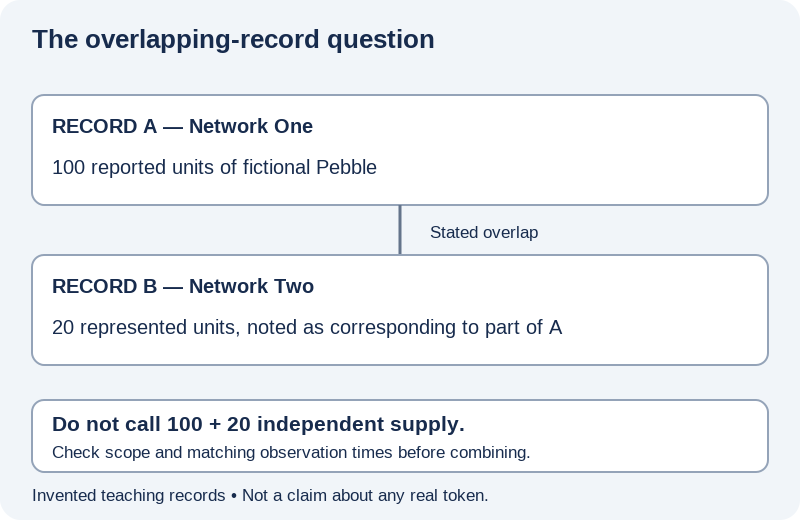
Imagine a teaching dataset with a fictional token called Pebble. Record A describes one hundred units on Network One. Record B describes twenty units represented on Network Two, with a note that those units correspond to a portion of A. Adding both as independent issuance would produce one hundred twenty, but the note indicates overlapping representation. The diagram should show the stated relationship and avoid calling the sum independent supply. This invented example illustrates a counting problem only; it does not describe any real token, bridge mechanism or backing arrangement.
03Publish the unresolved question
In the Pebble example, the next question is whether the twenty represented units are included in the one hundred reported units at the same observation time. If the source note cannot settle that, show both records without producing a combined supply figure. Retain their timestamps and the exact relationship asserted by the source. A later clarification can support a revised diagram, with the earlier version preserved. The resulting record is valuable because it exposes the assumption that needs checking, not because it turns incomplete information into a confident financial conclusion.